


01
Jul
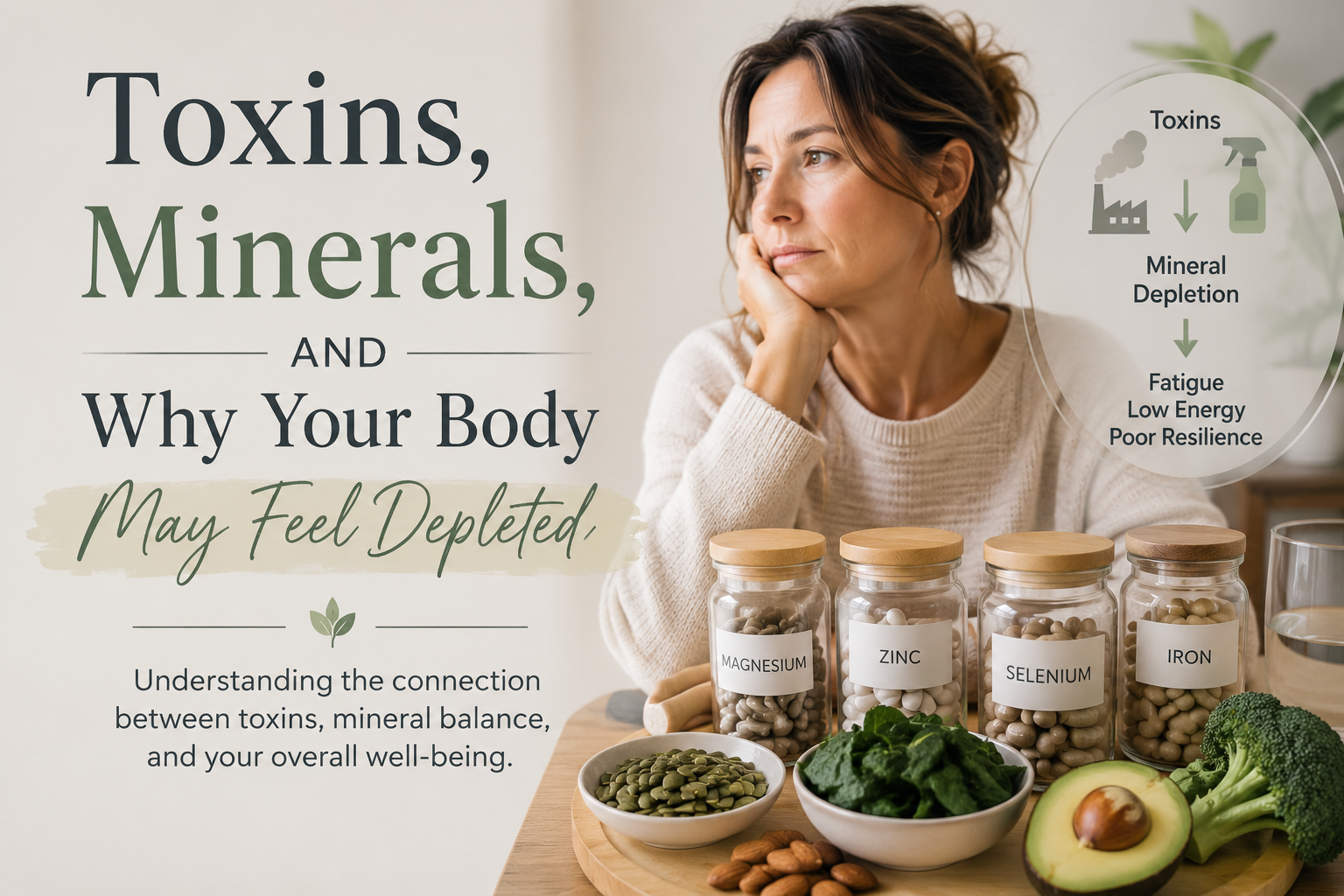
Toxins, Minerals, and Why Your Body May Feel Depleted
Have you ever felt like you’re doing everything “right”—eating healthier, taking supplements, trying to manage stress—yet you still don’t feel like yourself?
It’s something I hear from people all the time.
One piece of the puzzle that often gets overlooked is how everyday environmental toxins can affect the nutrients your body depends on, especially minerals.
While we often think about vitamins, minerals are just as essential. They help your body produce energy, regulate the nervous system, support healthy hormone function, build strong bones, maintain immune health, and activate hundreds of important biochemical processes.
When your body is exposed to ongoing environmental stressors, those minerals may become even more important.
Why Minerals Are So Important
Your body relies on minerals every single day.
Magnesium helps support relaxation, healthy sleep, muscle function, and energy production.
Zinc plays an important role in immune health, skin health, and tissue repair.
Selenium supports thyroid function and helps protect cells from oxidative stress.
Iron is essential for carrying oxygen throughout the body, helping you maintain energy and mental focus.
These are just a few examples, but together, minerals serve as the building blocks that allow your body to function the way it was designed to.
How Environmental Toxins Can Affect Mineral Balance
We encounter chemicals every day through the food we eat, the water we drink, the air we breathe, household products, and even personal care products.
Research suggests that some environmental toxins may interfere with the body’s ability to absorb, transport, or utilize certain minerals. Others may compete with essential minerals for the same pathways within the body.
Over time, these exposures may place additional demands on your body’s nutritional reserves.
This doesn’t necessarily mean toxins directly cause mineral deficiencies, but they may influence how efficiently your body is able to use the nutrients it depends on.
What This May Look Like
Because minerals are involved in so many systems throughout the body, inadequate mineral status or poor mineral utilization may contribute to symptoms such as:
Fatigue or low energy
Muscle tension or cramps
Difficulty recovering from stress
Trouble sleeping
Brain fog or difficulty concentrating
Hair shedding
Poor exercise tolerance
Feeling run down more often
These symptoms can have many different causes, but they also remind us how important it is to support the body’s nutritional foundation.
Everyday Examples
Scientists have studied how certain heavy metals interact with essential minerals.
For example, lead may interfere with calcium and iron metabolism. Cadmium may compete with zinc. Mercury has been shown to interact with selenium and zinc, two minerals that play important roles in protecting cells from oxidative stress.
These interactions highlight just how closely environmental exposures and nutritional health can be connected.
Supporting Your Body
While we can’t eliminate every environmental exposure, we can focus on supporting the body.
That starts with eating a nutrient-dense diet, supporting digestive health so nutrients can be absorbed effectively, staying hydrated, reducing unnecessary chemical exposures where possible, and making sure your body has the nutritional building blocks it needs.
At Nutritional Wellness Center, we believe that lasting wellness isn’t about chasing symptoms. It’s about understanding the many factors that may be influencing how your body functions and providing personalized nutritional support that helps your body work the way it was designed to.
Looking Beyond the Obvious
If you’ve been feeling tired, overwhelmed, or like your body just isn’t responding the way it used to, it may be worth looking beyond calories, exercise, or sleep alone.
Sometimes the conversation needs to include nutrient status, mineral balance, and the everyday environmental stressors that may be quietly affecting your health.
Small changes can add up over time, and supporting your body’s nutritional foundation is one of the most powerful investments you can make in your long-term wellness.
This article is intended for educational purposes only and is not intended to diagnose, treat, cure, or prevent any disease. If you have concerns about your health, please consult with your healthcare provider.
References
Agency for Toxic Substances and Disease Registry. The Interaction Profile for Toxic Substances.
https://pmc.ncbi.nlm.nih.gov/articles/PMC3453887/
Colorado State University. Mineral Absorption in the Small Intestine.
https://vivo.colostate.edu/hbooks/pathphys/digestion/smallgut/absorb_minerals.html
National Library of Medicine. Influence of Heavy Metals on Essential Mineral Metabolism.
https://pubmed.ncbi.nlm.nih.gov/6348941/
National Library of Medicine. Mercury, Selenium, and Human Health.
https://pmc.ncbi.nlm.nih.gov/articles/PMC8078867/
Oregon State University. Diet and Heavy Metal Exposure.
https://health.oregonstate.edu/aspire/resources/diet-heavy-metals
National Library of Medicine. Mineral Nutrition and Toxic Metal Interactions.
https://pubmed.ncbi.nlm.nih.gov/2484425/